Headline result: Around 18% suitable now, rising to around 58% by FY31.
At a Glance
Organisation: Healthcare transport organisation
Fleet: ~180 fleet assets
Suitable now: Around 18%
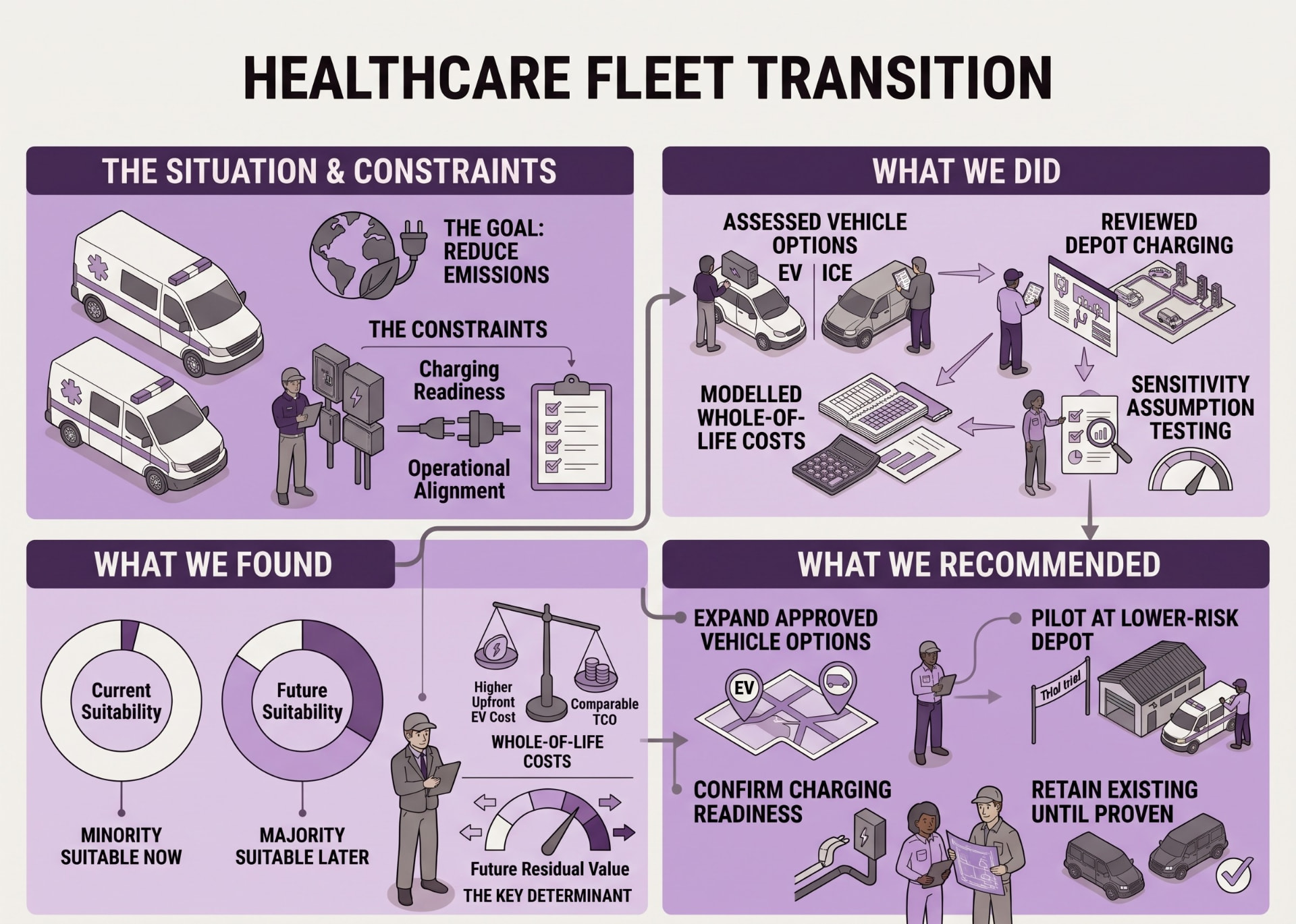
The Situation
A healthcare transport fleet sought a fleet transition plan to support its emissions reduction commitments while ensuring the transition met operational requirements.
The Constraint
Charging readiness was a key constraint. Site electrical information and operational charging requirements needed further assessment before rollout.
Vehicle options also needed to meet the organisation’s policy and operational requirements.
What We Did
We assessed operationally aligned vehicle options, reviewed depot charging readiness and modelled whole-of-life costs. Sensitivity testing explored the assumptions that could change the decision.
What We Found
Around 18% of the fleet was suitable for an electric option now, rising to around 58% by FY31.
Electric vans had a higher upfront cost but were modelled to save around $7,000 annually in running costs. Over five years, total cost of ownership for the EVs landed within about 1% of the internal-combustion vehicles.
Residual value was a key determinant in total cost of ownership. Various scenarios were modelled to help the client understand the potential range of outcomes.
What We Recommended
Expand approved vehicle options that meet policy and operational requirements. Pilot at a lower-risk depot, confirm charging readiness and present a business case that makes the assumptions and risks clear.
Retain existing vehicles until their electric replacements and supporting charging have been proven in operation.