
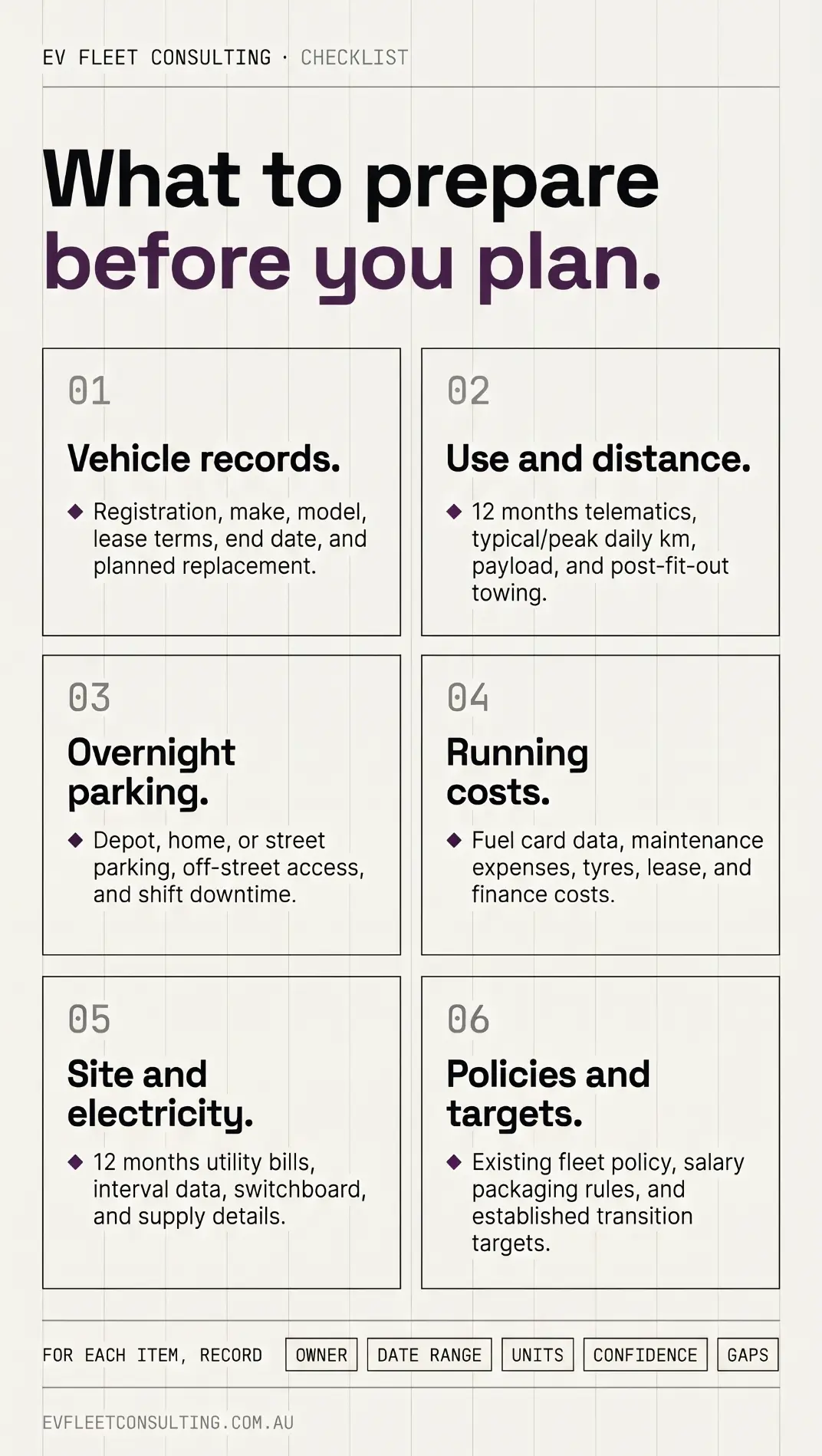
This is the data to gather before a fleet electrification plan: what each vehicle does, where it parks overnight, when it is due for replacement, what it costs to run, and the electricity supply at each site. Each item shows who usually holds it and how soon you need it.
You will not have all of it. A good plan states what was assumed and how confident it is in each input. This checklist supports Step 1 of our guide on how to electrify a fleet.
How to Use This Checklist
For each item, record these fields:
| Field | What to record |
|---|---|
| Data owner | The person or team that holds it, such as fleet, finance, facilities or your leasing provider |
| Source | The system or document it comes from |
| Date range | Ideally 12 months, so seasonal peaks are included |
| Units | For example kilometres, litres, kWh or kVA |
| Measured or estimated | Which one it is. Keep the two apart |
| Confidence | High, medium or low |
| Gaps and action | What is missing, and who will fill it |
Not every item applies to every fleet. Skip what does not fit yours.
Which Data Matters Most?
Each item below has a priority. Essential items decide which vehicles can change and where they will charge. Important items set costs, charging design and timing. Items marked later help you check and adjust the plan once it is under way.
Start with the essential items. You can begin planning with gaps in the important and later items, but resolve any gap that could change the answer before you commit to a large vehicle order or charging works.
Vehicle Records
| Data item | Usual owner | Priority |
|---|---|---|
| Registration, make, model and year (one row per vehicle) | Fleet or leasing provider | Essential |
| Vehicle type and body: car, SUV, ute, van, truck or plant | Fleet | Essential |
| Home depot or site where it parks overnight | Fleet or operations | Essential |
| Planned replacement date | Fleet | Essential |
| Fitout and accessories, with their weight | Fleet or workshop | Essential |
| Business unit and role | Fleet or operations | Important |
| Ownership or lease terms and end date, including any residual or balloon | Finance or leasing provider | Important |
Use and Distance
| Data item | Usual owner | Priority |
|---|---|---|
| 12 months of telematics, or odometer readings at regular intervals | Fleet or telematics provider | Essential |
| Typical and peak daily distance, and how often peak days occur | Fleet | Essential |
| Operating days, hours and shift patterns, including double shifts | Operations | Essential |
| Payload and towing on real jobs, after fitout | Operations or drivers | Essential |
| Trips over a set distance, such as 300 km | Fleet | Important |
| Fuel use per 100 km | Fleet or fuel card provider | Important |
| Seasonal peaks, such as summer heat, winter or harvest | Operations | Important |
| Downtime and time in the workshop | Fleet or workshop | Later |
A van that averages 90 km a day but does a 300 km regional run once a month needs a plan for that day. The average alone would hide it.
Where Vehicles Park Overnight
| Data item | Usual owner | Priority |
|---|---|---|
| Where each vehicle parks: depot, employee home or street | Fleet or drivers | Essential |
| How long each vehicle sits still between shifts | Operations | Essential |
| For vehicles kept at employees' homes: whether they park off the street, and whether the home is owned or rented | Drivers | Important |
| Access to existing chargers | Facilities or drivers | Important |
This decides where charging is needed and whether home charging is an option.
We can tell you which items matter most for your fleet. Request a free call.
Running Costs
| Data item | Usual owner | Priority |
|---|---|---|
| Fuel spend and fuel card data | Finance or fuel card provider | Important |
| Maintenance, tyres and repairs | Fleet or workshop | Important |
| Insurance and registration | Finance | Important |
| Lease or finance costs | Finance or leasing provider | Important |
| Fringe benefits tax paid on vehicles available for private use | Finance or payroll | Important |
Site and Electricity Data
Record this for each depot or site, and link it to the vehicles that park there.
| Data item | Usual owner | Priority |
|---|---|---|
| Address, and whether the site is owned or leased | Facilities | Essential |
| Vehicles that park at the site overnight | Fleet | Essential |
| 12 months of electricity bills and the network tariff | Facilities or finance | Essential |
| 12 months of interval data from the meter | Electricity retailer or network | Essential |
| Incoming supply and main switchboard details | Facilities or electrician | Important |
| Known connection constraints or planned upgrades | Facilities or network | Important |
| Parking layout and possible charger locations | Facilities | Important |
Interval data shows how much electricity the site uses now and when its peaks occur. It does not on its own tell you how much charging the site can support. That also depends on the capacity of the incoming supply, the switchboard and circuits, and the charging load you plan to add. A qualified electrical assessment confirms usable spare capacity.
Policies and Targets
| Data item | Usual owner | Priority |
|---|---|---|
| Fleet policy, including vehicle choice lists and safety requirements | Fleet | Important |
| Salary packaging and private use arrangements | HR or payroll | Important |
| Emissions or fleet targets already set | Sustainability or executive team | Important |
| Procurement rules and approval steps | Procurement | Later |
What If Data Is Missing?
Each way of filling a gap has limits:
| Method | What it can show | What it cannot show |
|---|---|---|
| Temporary trackers on a sample of vehicles | Real trip distances, peak days and parking locations for the period tracked | Seasonal peaks outside that period, unless you track for longer or repeat it |
| Fuel card data | Fuel bought and, where drivers enter odometer readings, a rough distance | Trip distances and peak days. Odometer entries at the bowser are often missing or wrong |
| Driver survey | Where vehicles park overnight and whether home charging is possible | Accurate distances. Check answers against other data where they affect the result |
| Interval data from your retailer or network | The site's current load and when it peaks | The site's spare capacity |
Mark estimated values as estimates, and replace them with measured data where it could change a decision.
What About Employee Privacy?
Trackers and surveys collect information about employees. Workplace surveillance rules differ between states and territories. NSW and the ACT, for example, have specific workplace surveillance laws with notice requirements. Check your obligations under surveillance, employment and privacy law before you track vehicles. Collect only what the plan needs, remove names where you can, and store the data securely. This checklist is not legal advice.
How Should You Share the Data?
Keep raw telematics and employee home addresses out of email and website forms. When we start a project, we agree a secure transfer method and ask only for the fields the analysis needs. For a first conversation, a summary of fleet size, vehicle types and sites is enough.
Frequently Asked Questions
What data do I need to electrify my fleet?
Vehicle records, distance and use data including peak days, overnight parking locations, running costs, site electricity data, and fleet policies. Start with the items marked essential.
Do I need telematics to plan an EV transition?
It helps, but it is not essential. Odometer readings, fuel card data and a sample of temporary trackers can fill much of the gap, with lower confidence.
Does interval data show how many chargers a site can take?
No. It shows the existing load. Spare capacity depends on the supply, switchboard and circuits, which a qualified electrical assessment confirms.
How long does it take to gather fleet data?
It depends on your systems. Fleets with telematics and central records can often gather most of it quickly. Others may need a few weeks.
Next Step
Not sure what you already hold? Request a free call and we will go through it with you in 30 minutes. Our Fleet Electrification Strategy and Roadmap service starts with this data.
For a transition plan tailored to your organisation, explore our Corporate Fleets and Councils & Government advisory pages.