
To electrify a fleet, start with your data, not with vehicles. Check which vehicles can go electric on their real daily duties, work out where and when they will charge, build a whole of life business case, then replace vehicles in stages as they fall due. Most fleets move over several years, not in one purchase.
This guide sets out the six steps we use with councils, government agencies and business fleets.
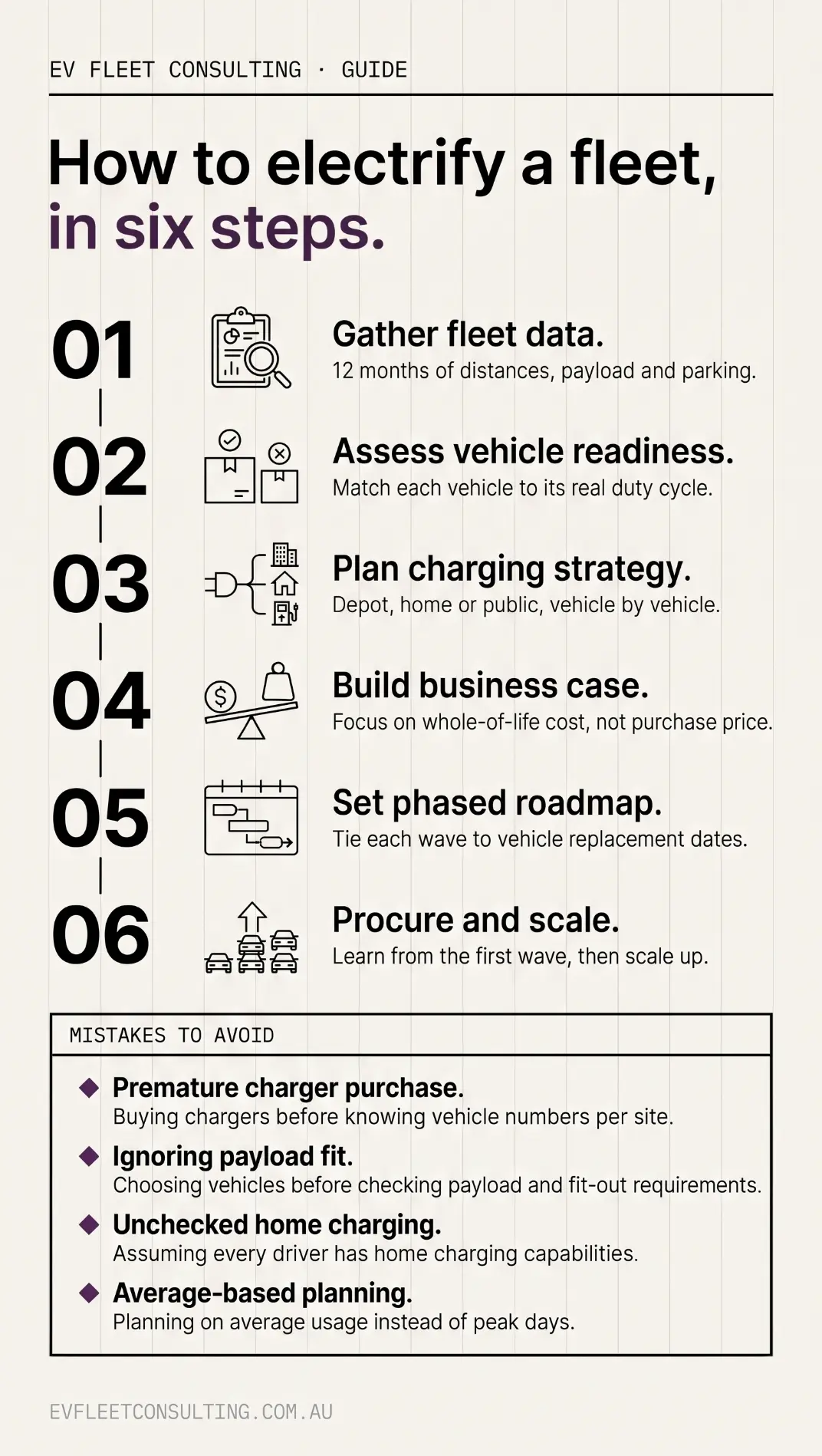
Step 1: Gather Your Fleet Data
Before anyone looks at a vehicle brochure, collect this for each vehicle:
- Make, model and type (car, SUV, ute, van, truck or plant)
- Odometer readings or trip data, ideally 12 months of telematics
- Typical and peak daily distances
- Payload and towing needs, including the weight of any fitout
- Where it parks overnight: depot, staff home or street
- Replacement date and current lease or ownership terms
A good plan states what data is missing and what was assumed in its place. Our fleet electrification data checklist lists every item, who usually holds it and what to collect first.
Step 2: Check Which Vehicles Can Go Electric
Score each vehicle against what it actually does. Look at peak days, not only averages. A vehicle that averages 80 km a day but runs 350 km twice a month needs a plan for those long days. That might mean charging during the day, a swap vehicle, or staying on petrol or diesel for now.
Specifications can rule out vehicles that would cope. In one council fleet we assessed, a heavy towing specification had ruled out an electric option for every ute. When we looked at what each ute did, most of them never towed.
That changed the answer for most of the fleet.
Sort each vehicle into one of three groups:
| Group | What it means | Evidence you need | Next action |
|---|---|---|---|
| Suitable now | An available electric model meets the vehicle's peak day distance, payload and towing, and it can charge where it parks | Peak day distance, payload after fitout, overnight location | Plan the change at its next replacement |
| Suitable with changes | It works if something changes, such as a charger at home, extra charging on long days or a different body | The same, plus the change that closes the gap | Test and cost the change |
| Not yet suitable | No available model meets the duty, or charging is not workable | The constraint that rules it out | Keep petrol or diesel for now and recheck at the next review |
As an illustration: a pool car that averages 60 km a day and parks at a depot overnight is usually suitable now. A ute that tows heavy loads on long trips a few times a month needs more investigation before you decide.
Step 3: Plan Where Vehicles Will Charge
Charging often sets the pace of a transition more than vehicle supply does. Work out how many vehicles will charge at each depot, at staff homes and on the road, and how long each vehicle sits still overnight. Then check each site in two stages.
Start with a screening. Use 12 months of interval data, electricity bills and site details to estimate the charging load and flag sites that are likely to be constrained. Interval data shows what a site uses now and when it peaks. It cannot tell you how much spare capacity the site has.
For the sites you plan to use first, get a detailed assessment. A qualified electrical contractor or engineer checks the incoming supply, main switchboard, circuits and existing peak load against the planned charging load. They also check whether load management, which spreads charging across the night, avoids the need for an upgrade.
Step 4: Build the Business Case
Compare the whole of life cost of each electric option with its petrol or diesel equivalent over the same term. State each assumption so others can check it:
- Analysis period, such as five years
- Annual kilometres for each vehicle
- Energy use per 100 km, and fuel use for the petrol or diesel option
- Electricity tariffs at each charging location, and fuel prices
- Charging infrastructure costs, shared across the vehicles that use it
- Purchase or lease costs, and how they are financed
- Residual value at the end of the term
- Maintenance, insurance and registration
- Tax treatment, including GST and fringe benefits tax (FBT)
For cars that employees use privately, FBT can change the result. Eligible electric cars can be exempt from FBT, depending on the car's value and when it was first provided. In May 2026, the Government announced it would cap the full exemption at $75,000 for arrangements made from 1 April 2027, and move to a 25% discount for arrangements made from 1 April 2029. It said existing leases would not be affected. Draft legislation was released in September 2026. Check the current position with the ATO and your tax adviser before you rely on it.
Show a low, central and high case rather than a single figure. Residual value, kilometres travelled and where vehicles charge often move the result more than the purchase price.
Planning a transition? Request a free call to talk through your fleet. It takes 30 minutes.
Step 5: Set a Phased Roadmap
Tie each vehicle's change to its replacement date. A roadmap usually starts with the easiest vehicles at the sites that already have charging capacity, then adds vehicles as leases end and charging is installed.
Treat the roadmap as a live plan. We rerun the vehicle shortlist and cost model every six months, and again whenever prices, models or policy change in a way that affects a decision. A capital decision is also a good point to rerun it.
Step 6: Procure, Roll Out and Review
Buy vehicles and chargers against clear specifications. Brief drivers before vehicles arrive. Do not remove a petrol or diesel vehicle from service until its electric replacement, and the charging that supports it, have been proven. Track energy use, costs and downtime in the first year, then feed those results into the next review.
What Mistakes Should You Avoid?
- Buying chargers before you know how many vehicles will use each site
- Choosing vehicles before checking duty cycles, payload and fitout weight
- Assuming every driver can charge at home
- Building the business case on averages instead of real peak days
- Treating the transition as one purchase rather than a program with decision points
Do You Need Outside Help?
Many fleets run the transition themselves with some specialist support. Others want an independent plan before committing capital. Our Fleet Electrification Strategy and Roadmap service covers steps 1 to 5. We are paid by clients, not suppliers, and we do not sell vehicles or install chargers.
Frequently Asked Questions
How do I start electrifying my company fleet?
Start by collecting data on each vehicle: daily distances, peak days, payload, where it parks overnight and its replacement date. Use that data to identify which vehicles can go electric now.
How long does a fleet transition take?
Most fleets transition over several years, in line with vehicle replacement cycles and charging installation. Few replace vehicles before the end of their lease or useful life.
What is the best way to transition a fleet to electric vehicles?
Phase it. Start with vehicles that suit electric operation at sites with charging capacity, prove them, then expand as vehicles fall due and infrastructure is installed.
Can every vehicle in my fleet go electric?
Not always, at least not yet. Vehicles that tow heavy loads or cover long distances may stay on petrol or diesel until suitable electric models are available.
Next Step
If you are working out where to start, request a free call. In 30 minutes we will go through your fleet and the first decisions to make. You do not need a complete dataset for the first conversation.
For a transition plan tailored to your organisation, explore our Corporate Fleets and Councils & Government advisory pages.