
To scope a council fleet electrification project, define the decisions the work must support, which assets are in scope, what data you can provide, and what you expect to receive. A clear scope gets comparable quotes, avoids variations and gives councillors a plan they can act on.
This article covers what to include and ends with a brief outline you can adapt.
What Decisions Should the Project Support?
Start with the decisions, not the deliverables. For example:
- Which vehicles and plant should change at their next replacement?
- What charging does each depot need, and when?
- What will the transition cost over the next budget cycles?
- What target can council commit to, and on what conditions?
Then turn those decisions into objectives a consultant can price and you can check. For example, the project will:
- Identify which vehicles are suitable for replacement with EVs, and why others are not
- Set out the charging infrastructure each depot needs
- Estimate transition costs across future budget cycles
- Identify the operational, financial and infrastructure risks
- Recommend a realistic order of implementation
Each objective shapes the analysis you need and the level of detail. Set objectives that match council's own commitments, not a template from another council.
Who Sponsors the Project Inside Council?
Name an internal sponsor with authority over fleet, budget and depots. Without a sponsor, decisions stall between teams. Then list who contributes what:
- Fleet: vehicle use, replacement schedules and operating needs
- Facilities: depot infrastructure and site access
- Finance: budgets, whole-of-life costs and funding
- Procurement: tender requirements and purchasing arrangements
- Sustainability: emissions objectives and reporting
- IT: telematics, fleet management systems and charging software
- Drivers, mechanics and depot staff: how vehicles are really used, and how charging will work day to day
Fleet electrification changes how depots operate. It is not only a vehicle purchase.
Which Assets Are in Scope?
Council fleets are mixed. Be clear about which of these are included:
- Passenger cars and pool vehicles
- Utes and vans
- Trucks
- Plant and equipment, such as mowers, loaders and small tools
- Vehicles provided to staff for private use
Some councils start with light vehicles and add trucks and plant in a later stage. Say which approach you are taking, so every proposal prices the same scope.
What Data Can Council Provide?
A vehicle's suitability depends on how it is used, not only its age or type. Where you have it, provide:
- An asset register with registration or asset ID, make, model, type, configuration, age and replacement date
- Annual kilometres or operating hours
- Typical daily routes and duty cycles, from telematics or odometer records
- Payload, towing and fitted equipment
- Fuel use, from fuel card data
- Whether each vehicle is owned or leased, and the replacement arrangements
- How critical each vehicle is, and how often it must be available
- Depot locations, electricity bills and interval data
Our fleet electrification data checklist lists the full set. Most councils will not have all of this at the start. Gaps are normal. The scope should say how gaps will be handled and who fills them.
Desktop or Electrical Site Assessment?
Be specific about the level of site work:
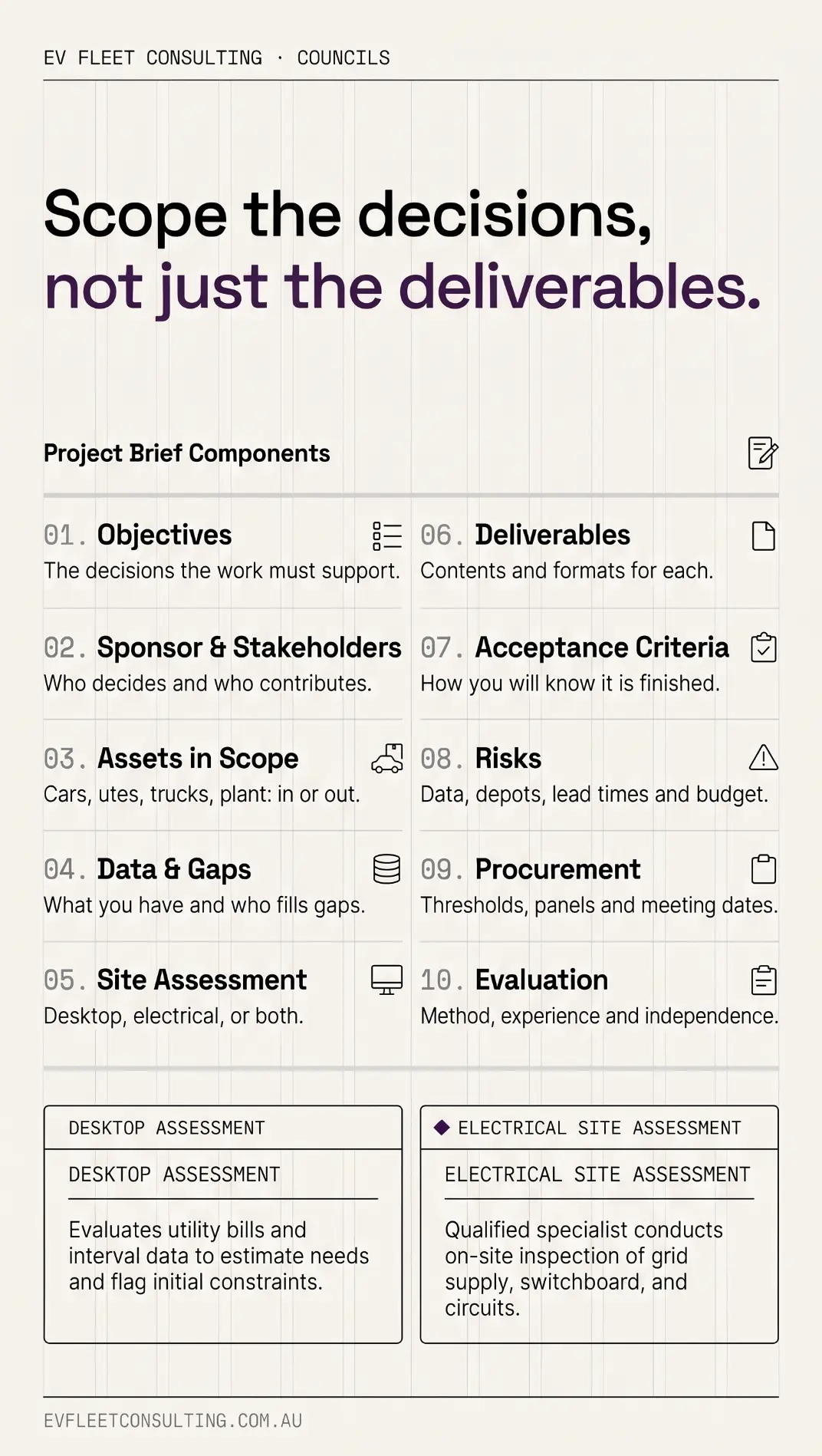
- Desktop assessment: uses bills, interval data and site information to estimate charging needs and flag likely constraints. It does not confirm spare electrical capacity.
- Electrical site assessment: a qualified electrical specialist inspects the existing supply, switchboard and relevant circuits and identifies what further investigation each site needs. How much it confirms depends on the agreed scope.
Detailed electrical design, network connection applications and installation are usually separate pieces of work. Say in the brief whether any of them are included.
Many councils start with a desktop assessment across all depots and commission electrical assessments for the sites in the first wave. Grid connection upgrades can be among the largest costs and longest lead items in a fleet transition, so the sites in the first wave need the detailed work early. Our guide to depot charging for fleets explains how charging needs are worked out.
Preparing a brief? Request a free 30-minute call to talk through the scope.
What Should the Deliverables Be?
List each deliverable and what it must contain:
- Fleet baseline: asset inventory, usage profile and data gaps
- Vehicle suitability: recommended replacement options, and the reason for each exclusion
- Depot assessment: charging needs, constraints and a confidence level for each site
- Whole-of-life cost model: assumptions, scenarios, cost categories and the comparison period
- Roadmap: stages, replacement timing, budget impacts and dependencies
- Council briefing: main findings, options, risks and the decisions required
State the format of each. Ask for the cost model in editable form with a licence to use and update it after the project. Who owns the underlying intellectual property is a separate point to settle in the contract.
How Will You Accept the Work?
Set acceptance criteria in the brief, so there is no dispute about whether the work is finished. For example:
- Every asset in scope is accounted for, with a suitability result and the reason
- Exclusions, data gaps and assumptions are listed, with their sources
- Each recommendation can be traced to the evidence behind it
- Depot findings say which figures are desktop estimates and which come from electrical assessment
- Costs are shown by stage and financial year
- The cost model is editable and supplied in the agreed format
- The final report sets out the decisions needed, the dependencies and any unresolved risks
How Should You Evaluate Proposals?
The lowest fee does not tell you the quality or independence of the advice. Follow council's own procurement policy, and consider asking each consultant for:
- Their method, assumptions and exclusions
- Experience with comparable fleets and council settings
- The qualifications of the people doing the technical work
- The project team, their roles and their availability
- Independence from vehicle, charger and equipment suppliers, with any conflicts of interest declared
- How they will store and handle council fleet data
State the evaluation criteria, and their weighting where council's policy allows, in the brief.
What Procurement Dependencies Should You Note?
- Council's procurement thresholds and the process the project falls under
- Any panel or contract the vehicles and chargers must be bought through
- Timing of council meetings and budget cycles
- Grant or funding deadlines that the work needs to meet
What Risks Should the Scope Cover?
Ask the consultant to identify and rate these early:
- Incomplete or inconsistent fleet data
- Depot electrical constraints
- Vehicle availability and delivery lead times
- Changes to how vehicles are used
- Budget approval and procurement timing
- Uncertain grant funding
- Landlord approvals and site access
- The timing link between buying vehicles and installing chargers
A Brief Outline You Can Adapt
- Background and objectives, including any emissions targets and the decisions the work must support.
- Internal sponsor and stakeholders, with what each contributes.
- Assets and sites in scope, including whether trucks and plant are in or out.
- Data available and known gaps, with owners.
- Level of site assessment: desktop, electrical, or desktop with electrical for named sites, and whether design or connection work is included.
- Deliverables, contents and formats, including the editable cost model and licence terms.
- Acceptance criteria.
- Risks the consultant must assess.
- Procurement dependencies and timeline, including council meeting dates.
- Evaluation criteria for proposals, including independence from vehicle and charger suppliers.
What Mistakes Should Councils Avoid?
- Leaving plant and equipment undefined, which leads to variations later
- Not involving depot staff and mechanics early
- Setting targets before checking depot electrical capacity
- Asking for a target without asking for a costed plan to meet it
Frequently Asked Questions
How do councils start fleet electrification?
Define the decisions council needs to make, name an internal sponsor, gather fleet and depot data, and scope a suitability, charging and cost assessment that leads to a phased roadmap.
Should councils assess vehicles and depot charging together?
Yes. Vehicle suitability, daily duties, time parked at the depot and depot electrical capacity depend on each other. A vehicle can be suitable on its own and still be impractical if the depot cannot support its charging.
Should plant and equipment be included?
It depends on council's goals. Many councils start with light vehicles and add plant later. State the choice in the scope.
What is the difference between a desktop and an electrical site assessment?
A desktop assessment estimates charging needs from bills and interval data. An electrical site assessment, by a qualified specialist, inspects the existing supply, switchboard and circuits and identifies what further work each site needs.
How long does a council fleet transition plan take?
It depends on fleet size, data quality and the number of depots. Ask each consultant for a timeline based on your scope.
Next Step
If council is preparing a fleet electrification brief, request a free 30-minute call. Our Fleet Electrification Strategy and Roadmap service works with councils from scope to roadmap.
Explore our Councils & Government fleet advisory for support with your council fleet transition project.