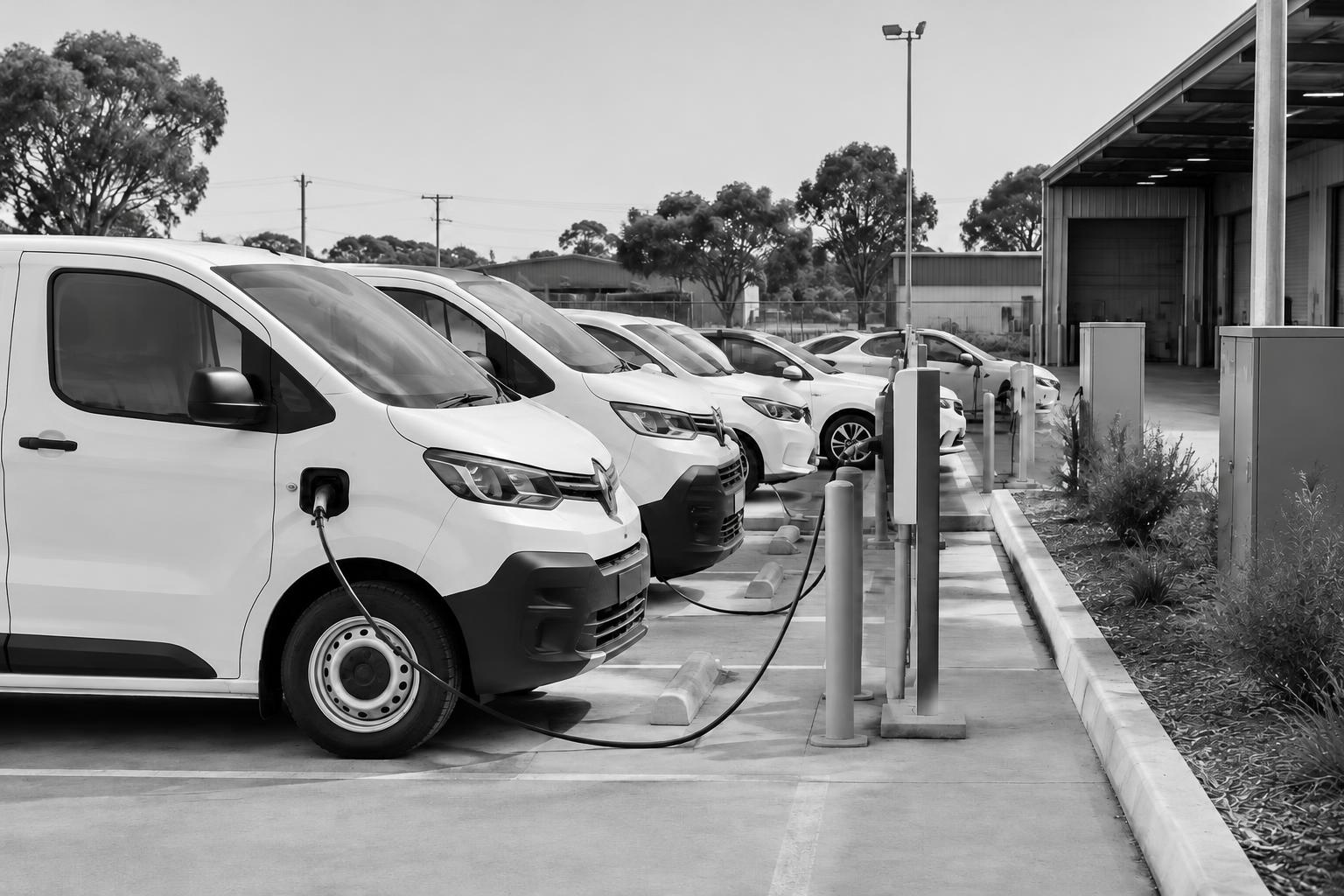
To plan EV charging for fleets at the depot, start with how much energy each vehicle needs and how long it sits at the depot. Then check whether the site's electrical supply can deliver that energy in the time available. Only then choose chargers. A charger's rating does not tell you what a vehicle will draw or what the site can supply.
This article walks through the decisions in order.
Depot Charging or Public Charging?
Depot charging is the charging you control: at your own sites, on your schedule and at your electricity tariff. Vehicles that return to base each day can usually do most of their charging there. Public charging fills gaps for vehicles that work away from the depot, travel long distances or go home with staff. Plan depot charging first, then decide which vehicles need a backup on the road.
How Much Energy Does Each Vehicle Need?
Start with daily distance and energy use per kilometre on real, loaded duties. Manufacturer figures are a starting point, but payload, fit-out, towing, heat and cold all change energy use. Telematics or trial data from your own routes is better evidence. Our fleet electrification data checklist lists what to collect.
Illustrative example. A vehicle travels 120 km a day and uses 0.2 kWh per km.
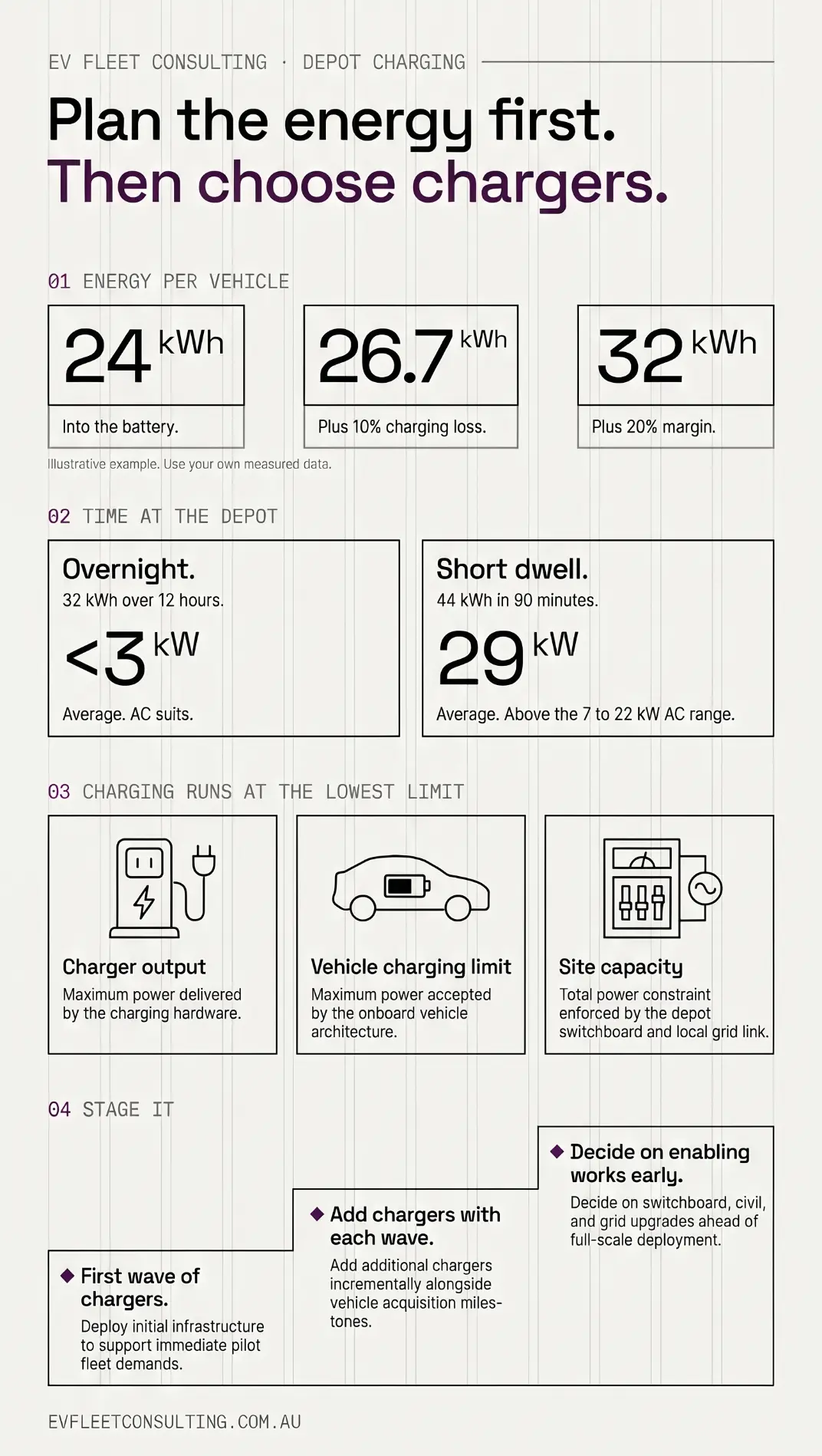
- Vehicle energy: 120 km × 0.2 kWh/km = 24 kWh into the battery
- Charging losses: some energy is lost between the meter and the battery. If 10% is lost, the site supplies 24 ÷ 0.9 = about 26.7 kWh
- Operating margin: allow for peak days and battery ageing. Adding a 20% margin gives 26.7 × 1.2 = about 32 kWh per vehicle per day
These figures are illustrative planning assumptions, not measured values. Use each vehicle's measured distances and energy use, and confirm loss and margin assumptions with your electrical designer.
Then add the vehicles up. Ten vehicles like this one need about 320 kWh from the site each night. If they all charge in a 10 hour window, that averages 32 kW. If they all start at full power the moment they plug in, the peak is much higher. That gap is where load management helps.
How Long Do Vehicles Stay at the Depot?
Dwell time decides how fast each vehicle needs to charge. Divide the energy needed by the hours available.
- Overnight dwell. The vehicle above needs about 32 kWh and is parked for 12 hours. That is an average of under 3 kW, well within the range of a typical AC charger.
- Short dwell. A van on double shifts returns with 90 minutes before its second shift and needs about 44 kWh from the site to complete it. That is an average of about 29 kW, above the typical 7 to 22 kW range for AC charging. DC charging may suit, provided the vehicle supports that rate. Changing the shift pattern, rotating vehicles or adding a short charge during the day may also lower the power needed.
Map when each vehicle arrives and leaves. That tells you how many vehicles charge at the same time, which ones must leave first and what the site has to supply.
Which Chargers Do Fleets Use?
The Australian Government's guide to EV charging equipment describes Level 2 AC charging as typically 7 to 22 kW.
- AC chargers suit vehicles that park for long periods, such as overnight. They cost less to buy and install.
- DC chargers deliver much higher power. They suit short dwell times, double shifts and vehicles with high energy needs, such as trucks, and they cost more and draw more from the site supply.
The charging rate you get is set by the lowest of three limits:
- The charger's output
- The vehicle's own charging limit. For AC this is the onboard charger, and many vehicles accept less than 22 kW. For DC it is the vehicle's maximum DC rate
- The capacity available at the site and on that circuit
A 22 kW AC charger does not make a vehicle with a 7 kW onboard charger draw more than 7 kW. A larger DC charger does not charge a vehicle faster than the vehicle allows. Check vehicle specifications before you size chargers, so you do not pay for power the vehicles cannot use.
Light vehicles that park overnight can often rely mostly on AC charging. Trucks, double shifts and other duties with high energy needs often need DC. The energy and dwell calculation above tells you which applies to each vehicle.
Can Your Site Supply the Power?
This is the question that most often changes the plan. Before charger design starts, gather:
- The site's existing maximum demand and load profile, from 12 months of interval data
- The capacity of the incoming supply
- The capacity and condition of the main switchboard
- The spare capacity on the circuits that would feed chargers
- Proposed charger locations and cable routes
- Whether the network needs to approve or upgrade the connection
- Whether the site is leased, and what the landlord allows
Interval data shows the existing load. It does not confirm spare capacity on its own. A qualified, licensed electrical specialist must assess the installation, and network approval may be needed before work starts.
What Load Management Does
Load management software shares the available capacity across chargers. If ten vehicles plug in overnight, the system can give power first to the vehicles that leave earliest or need the most energy, then spread the rest across the night. That can avoid or delay an expensive supply upgrade.
Load management does not create new capacity. It makes better use of the capacity the site already has.
Planning chargers for a depot? Request a free 30-minute call before you buy.
How Should You Stage Charging?
Install charging in step with your vehicle roadmap. A common approach:
- Install chargers for the first wave of vehicles only
- Add chargers as each wave of vehicles arrives
- Decide whether to run cabling and switchboard capacity for later waves now
Doing that enabling work once can cost less than coming back. It can also tie up capital in infrastructure that is not used if fleet plans change. Weigh it against how confident you are in the fleet growth, the electrical design and the upfront cost.
Staging keeps capital in step with need and lets you learn from the first wave.
What Does Depot Charging Cost?
Charger prices are only part of the cost. Ask suppliers to quote each of these, or say which they exclude:
- Chargers and associated equipment
- Site assessment and electrical design
- Cabling, trenching and installation
- Switchboard or supply upgrades
- Network connection costs, where they apply
- Load management software and subscriptions
- Ongoing maintenance and operation
A desktop estimate is a starting point. A site inspection and electrical design confirm the real cost. Some state programs have funded part of the cost of fleet chargers. Eligibility, funding and deadlines change, so check the current program page before you plan around one.
Frequently Asked Questions
How do I set up EV charging at a depot?
Work out each vehicle's daily energy need and dwell time, check the site's electrical capacity, choose chargers to suit, then stage installation with your vehicle rollout. Use qualified electrical designers and installers for the works.
Do fleets need DC fast chargers?
Usually only where vehicles have short dwell times, double shifts or high energy needs, and only if the vehicles can accept DC at the required rate. Divide each vehicle's energy need by the time it is parked to see which applies.
Will a bigger charger charge my vehicles faster?
Only up to the vehicle's own limit. Charging runs at the lowest of the charger's output, the vehicle's charging limit and the capacity available at the site.
What infrastructure does a fleet need to go electric?
Chargers, enough electrical capacity at each site, load management where capacity is tight, and a plan for vehicles that charge at home or on the road.
Can I install chargers at a leased depot?
Often yes, but you need the landlord's approval and should agree who owns the chargers at the end of the lease.
Next Step
Charging is one step in a wider plan. Our guide on how to electrify a fleet covers the full sequence. Councils preparing a brief can read our guide to scoping a council fleet electrification project.
Before you buy chargers, request a free 30-minute call. Our EV Infrastructure Planning and Procurement service prepares charging plans and specifications ready for procurement, with electrical design and installation by qualified specialists.
For a transition plan tailored to your organisation, explore our Corporate Fleets and Councils & Government advisory pages.